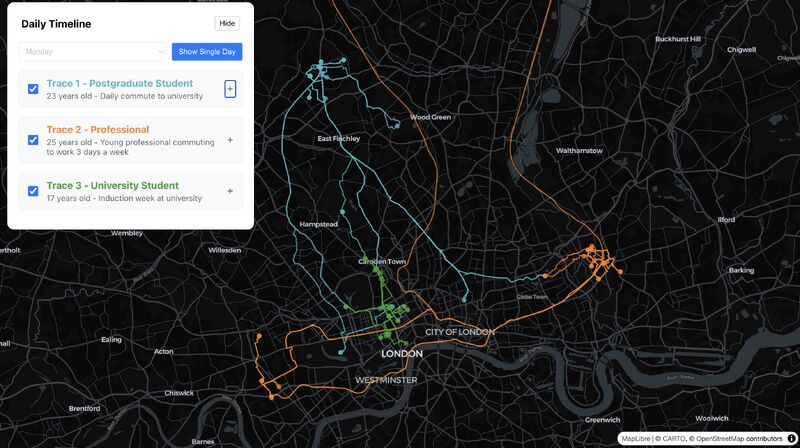
As part of the 2024 30-Day Map Challenge, I set myself a strange experiment: could an AI imagine what it’s like to live a week in London? Not just drawing lines on a map, but actually planning routines the way a person might — commuting, studying, playing sports, and finding time for food and music.
Traditional mobility models are good at predicting where people go, but not so good at explaining why, as our movement through a city is structured by habits, constraints, and motivations. Large Language Models (LLMs), with their knack for storytelling and reasoning, seem oddly suited to the task.
From Personas to Plans
I started not with real data, but with personas. A 25-year-old commuting from Stratford, newly married and juggling work with badminton and food outings. A 24-year-old postgraduate student in North Finchley, short on time and usually tethered to university and nearby parks. A 17-year-old near Warren Street, in love with records and small gigs, weekends orbiting around London’s indie music scene.
Each persona became a seed: a bit of narrative, a home base, a rough commute pattern, a set of interests. The job of the AI was to turn this into a plausible weekly routine.
I designed a two-level planning system. At the top, a “weekly planner” sketched the rhythm of the week — which days were for work, which for study, which for leisure. At the next level, a “day planner” expanded each slot into concrete activities: leaving home at 8:10, studying in a library until lunchtime, playing badminton in the evening.
Of course, an AI left to itself can get fanciful. To anchor these plans in the real city, I connected the system to Google Places and Directions APIs. When the model proposed “go to a library in Bloomsbury,” the system pulled up actual libraries, checked their opening hours, and calculated realistic routes and travel times.
This grounding step mattered. It meant the AI couldn’t simply teleport from Finchley to a gig in Camden in five minutes. Each leg of the day had to fit into the clock and the map. If something failed — a venue was closed, a trip took too long — the system would push back, asking the model to repair the plan.
The final plans were exported into a format that could be animated on a map. Using Deck.GL, I built an interface where you can watch each persona’s week unfold, day by day, trip by trip.
At a high level, the sequence would be planner → daily planner → grounding → validation → export → visualization.
The planner can be thought of as searching for a weekly itinerary that is plausible for a persona while respecting spatial and temporal constraints:
What Emerged
The results were often startlingly coherent. The 25-year-old’s map filled with Stratford anchors and regular commutes to West Kensington, dotted with food trips on the weekend. The 24-year-old circled between campus, parks, and home, mostly on foot or bike. The 17-year-old gravitated toward record shops and gig venues around central London.
But there were quirks too. The AI occasionally slipped in odd detours — a café visit in the middle of a lecture, or a badminton session at the London Aquatics Centre that doesn’t actually host badminton. These failures were as revealing as the successes: they showed where the model needed firmer constraints or a better sense of routine.
Related Work
Around the same time, Wang et al. (2024) published a paper treating LLMs as “urban residents.” Their approach starts with historical check-in data, extracts activity patterns, and uses the model to generate daily routines grounded in those patterns. They further tested scenarios like pandemic lockdowns, showing how mobility shifts when external constraints are applied.
My project comes from the opposite direction. Instead of data-first, it’s persona-first. Instead of statistical benchmarks, I leaned on qualitative plausibility and interactive exploration.
Lessons and Next Steps
What emerged from this experiment is that large language models (LLMs) are surprisingly adept at temporal sequencing — they can arrange activities so that “a day looks like a day.” But this generative fluency only becomes practically useful when grounded in constraints. Once real-world inputs like travel times, opening hours, and verified points of interest (POIs) are introduced, what begins as vague narrative output transforms into a spatially coherent itinerary you can actually walk across a map.
The shortcomings point toward clear next steps. Models lack continuity across days; adding memory of the previous week’s activities could make routines evolve more realistically. Pre-filtering POIs by opening hours before passing them into the model would cut down on impossible itineraries. And “scenario prompts” — for example, simulating a week of heavy rain or a citywide Tube strike — could test whether models adaptively restructure mobility under changing constraints.
For now, the maps remain playful artifacts, but they gesture toward something larger: the use of generative systems not just to predict where people might go, but to explore how motivations, constraints, and disruptions shape lived space. This may warrant further exploration in the future.
Footnotes
Scope
This is a qualitative, persona-led exploration, not a calibrated mobility forecast.